Australians spent $82.6 billion online in 2025, up 14% on the year before, and a record 9.8 million households shopped online, according to the Australia Post eCommerce Industry Report 2026. For any business that wants a share of that spend, the first big decision is where to sell: your own online store, an established marketplace, or both.
Your own store gives you control of the brand, the customer and the data. A marketplace gives you an audience on day one, in exchange for a cut of every sale. This guide compares the main ecommerce platforms and online marketplaces in Australia on cost, reach and control, so you can choose the best platform to sell online for your stage. If you are still setting up, start with our guide on how to start an ecommerce business.
Option A: Ecommerce Platforms (Your Own Store)
An ecommerce platform is software you use to build and run your own online store. You pay a subscription and payment processing fees, and you are responsible for bringing in traffic. In return, every customer, email address and product review belongs to you, and the content you publish builds search rankings for your own domain. Prices below were checked in October 2026.
Shopify
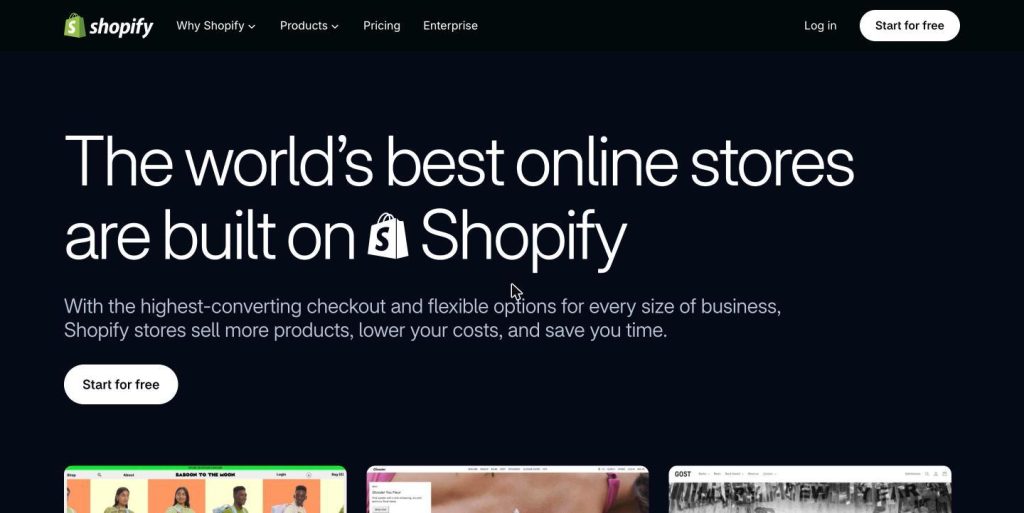
Shopify is the most common choice for Australian small businesses. The Basic plan costs A$56 a month, or A$42 a month billed yearly, and Shopify Payments charges 1.7% + 30c per domestic online card sale. If you use a third-party payment provider instead, Shopify adds a 2% fee on Basic. Industry estimates from AfterShip put Shopify behind roughly 42% of Australian online stores, with built-in support for Afterpay, Australia Post and GST.
WooCommerce
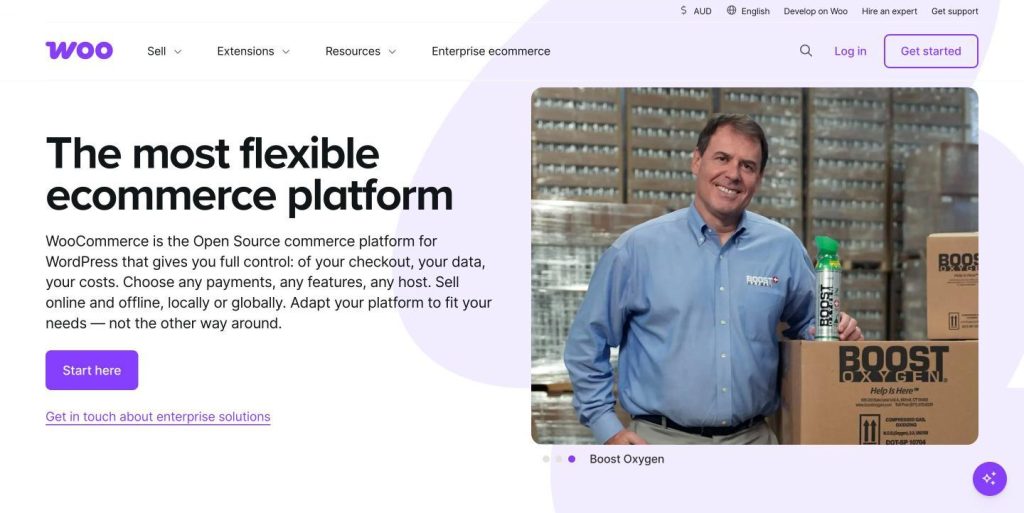 WooCommerce is a free plugin that turns a WordPress site into a store. There is no monthly platform fee, but you pay for hosting, which WooCommerce estimates at US$25 to US$350 a month, plus any paid extensions. WooPayments charges 1.75% + 30c per domestic card transaction in Australia. It suits businesses that already run WordPress and want full ownership.
BigCommerce
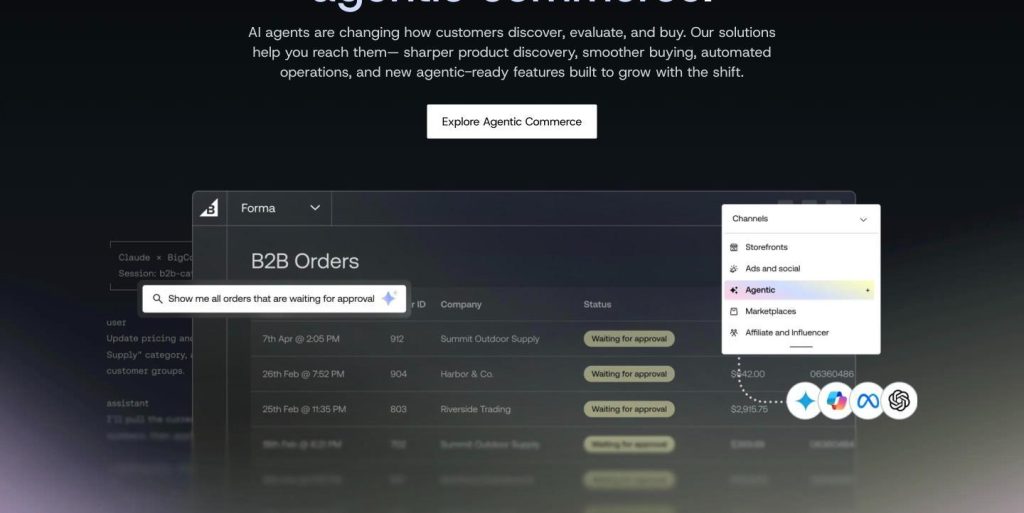 BigCommerce suits larger catalogues and B2B sellers. Its Core plan starts at US$39 a month, or US$29 a month billed yearly. Since June 2026 it charges an open payment provider fee of up to 2% unless you use one of its embedded payment providers, such as Stripe, PayPal or Afterpay.
Squarespace and Wix
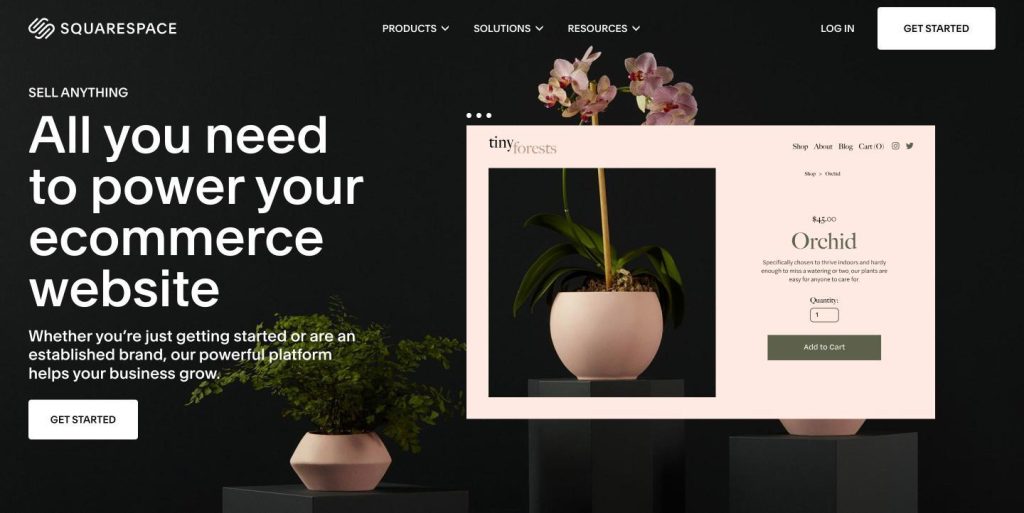 Squarespace and Wix are website builders with ecommerce built in, a good fit for design-led brands with smaller ranges. Squarespace Core costs US$39 a month (US$29 billed yearly) with no Squarespace transaction fee, and Wix’s cheapest selling plan starts at US$36 a month. Both price by region, so check the local price before you sign up.
Option B: Online Marketplaces
A marketplace lets you list products alongside other sellers on a site that already has shoppers. Australians spent $18.9 billion on pure online marketplaces in 2025, 23% of all online spend, according to Australia Post. The local field has also narrowed: Wesfarmers wound down Catch in 2025, and Woolworths closed the MyDeal website in September 2025. The trade-off is control. You work within each marketplace’s rules, listing templates and fees, and the customer relationship stays largely with the platform.
Amazon Australia
 Amazon now reaches 60% of Australian shoppers, according to Pattern’s 2026 Marketplace Consumer Report. The Professional selling plan costs A$49.95 a month (excluding GST), and most referral fees sit between 6% and 15% of the sale price depending on the category. For setup, listings and fulfilment options, read our guide on how to sell on Amazon Australia.
eBay
 eBay remains a major Australian marketplace, with 51% of shoppers planning to use it in 2026 according to Pattern. Since April 2026, Australian sellers with sales of A$25,000 or less over 12 months pay no final value fees, and buyers pay a protection fee instead. Business sellers on eBay’s Pro plans pay a final value fee, for example 13.4% + 30c per order on Pro Starter.
Etsy
 Etsy suits handmade, vintage and creative products. It charges a US$0.20 listing fee, a 6.5% transaction fee, and payment processing of 3% + A$0.25 for domestic sales on an Australian bank account.
Temu, Kogan and other marketplaces
Temu opened its Local Seller Program to all Australian-registered businesses with locally stocked inventory in July 2025, and Pattern found 47% of Australian shoppers use it. Kogan Marketplace reaches about 15%. These platforms can add volume, but fees are not always published, so confirm terms before you list.
Own Store vs Marketplace: Head-to-Head
Four criteria decide the choice for most Australian sellers.
| Criteria | Own store (Shopify, WooCommerce) | Marketplace (Amazon, eBay, Etsy) |
|---|---|---|
| Setup and fees | Monthly subscription plus 1.7% to 2% card fees | Low setup; 6% to 15% commission per sale |
| Audience reach | You drive your own traffic | Built-in shoppers from day one |
| Brand control and customer data | Full design control; you own the customer list | Standard templates; the marketplace owns the customer |
| SEO ownership | Rankings and content build long-term value for your domain | Visibility depends on the marketplace’s search and ads |
Cost is where the difference is easiest to see. On a A$50 sale, a Shopify store pays about A$2.27 in fees, while Amazon and eBay business sellers pay A$7 or more.
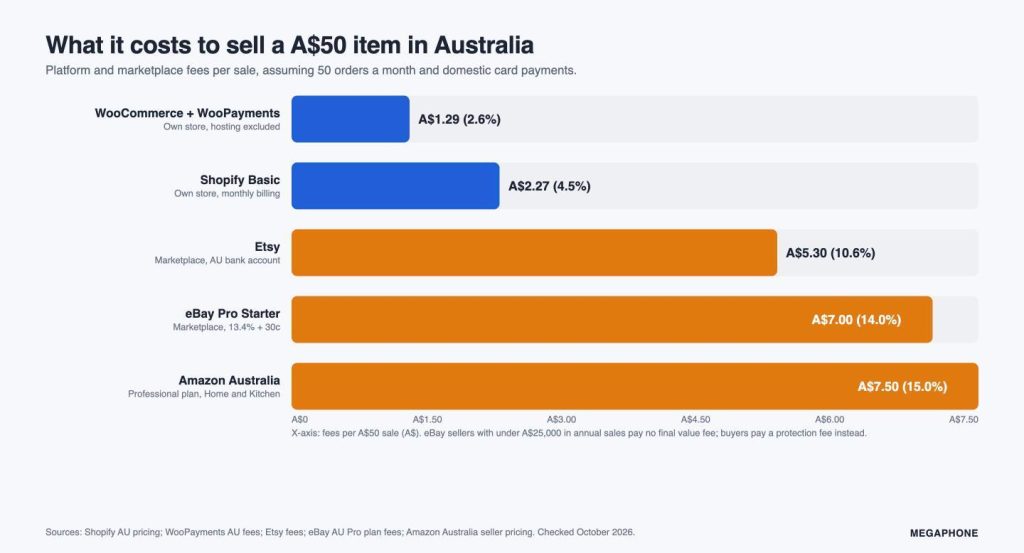
Fees per A$50 sale, assuming 50 orders a month and domestic card payments, with no advertising, apps or fulfilment costs. Sources: Shopify AU pricing (Basic, monthly billing), WooPayments AU fees (hosting excluded), Amazon Australia seller pricing (Professional plan, Home and Kitchen 13%), eBay AU fees (Pro Starter, 13.4% + 30c), Etsy fees (AU bank account). Checked October 2026.
Verdict: Which Should You Choose?
Your product, budget, and growth stage should decide the channel:
- Choose a marketplace if you are testing a new product, have no existing audience, or sell commodity items where buyers search by product rather than brand. eBay’s free selling tier makes a low-risk test for small sellers.
- Choose your own store if you have a clear brand, repeat customers and healthy margins, and want to own your customer list and search rankings. Fixed fees make each sale cheaper as volume grows.
- Run both once your stock and fulfilment are reliable. Many growing Australian brands use Amazon or eBay to reach new customers and their own store to keep them.
Budget matters too. A marketplace needs little upfront spend but takes more from every sale, while your own store asks for time and money upfront to build traffic through SEO, email and ads. If you have a small budget and a product that already sells well on Amazon or eBay, start there and use the profit to fund your own store later.
Most sellers start in one place and expand. The key is to model your fees at your expected volume before you commit, because a commission that looks small at 20 orders a month becomes your biggest cost at 2,000.
Grow Your Sales with Megaphone
Whether you sell through your own store, a marketplace or both, Megaphone helps Australian brands grow online. If Amazon is part of your plan, our Amazon marketing services cover listings, advertising and growth strategy for Australian sellers. Talk to our team about the right channel mix for your products and margins.