Most Australian businesses have spent years investing in SEO. The way people search has changed beneath that investment. Google now answers many questions directly on the results page, and millions of people ask ChatGPT, Gemini, and Perplexity for recommendations instead of scrolling through links.
According to BrightEdge, AI Overviews appeared on about 48% of tracked Google queries by February 2026, up from roughly 30% a year earlier. SparkToro found that 68% of US Google searches ended without a click to any website in early 2026. Two newer disciplines have grown out of this shift: generative engine optimisation (GEO) and answer engine optimisation (AEO).
This guide explains what SEO, GEO and AEO each mean, where they overlap, and which ones your business needs right now.
What Is SEO (And Why It Still Matters)
The basics
Search engine optimisation (SEO) is the work of getting your website to rank in the traditional organic results on Google and Bing. It rests on three pillars:
- Technical SEO: site speed, mobile usability, crawlability and indexing, so search engines can read every page.
- On-page SEO: matching each page to what a searcher wants, with clear titles, headings, content, and internal links.
- Off-page SEO: building authority through backlinks and mentions from other trusted websites.
SEO covers organic results only. Paid ads at the top of the page belong to search engine marketing, which we explain in SEO vs SEM: what’s the difference.
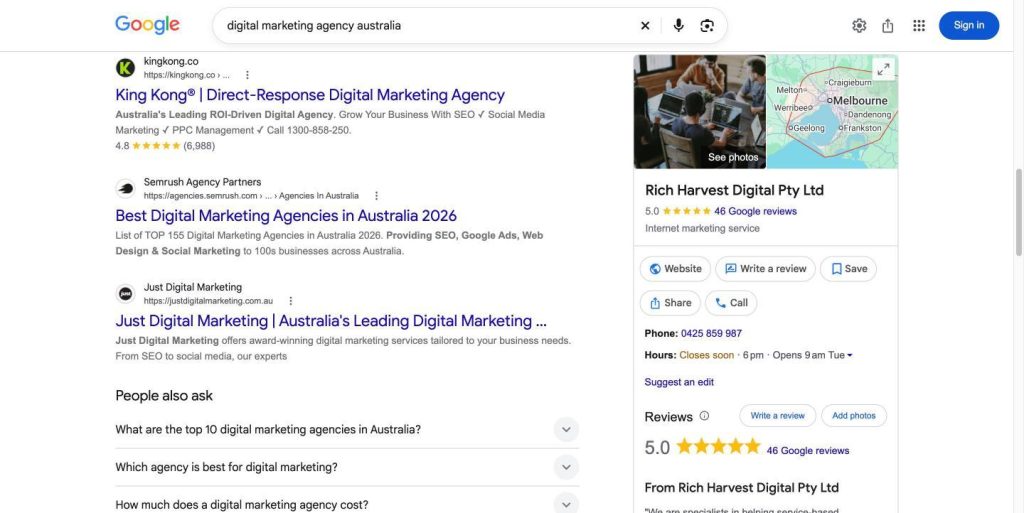
Organic results in a Google search for “digital marketing agency australia”. This is the space traditional SEO competes for
What SEO actually does for your business
SEO builds sustainable organic traffic, brand visibility, and leads over time. It is not a quick win, and most sites need three to six months of consistent work before rankings move. The results compound, though: a page that ranks well keeps earning clicks month after month without a cost per click, and every strong page makes the next one easier to rank.
Search is still a major source of the traffic you can win. Semrush’s 2026 Traffic Channel Mix Study of more than 50,000 websites found organic search delivered a median 16% of website traffic, compared with 0.49% for paid search and just 0.14% for AI platforms. On cost, Terakeet’s analysis of its client data found organic search acquired customers at 87.4% lower cost than paid search on average.
What Is GEO (Generative Engine Optimisation)?
How AI search works
AI search tools such as ChatGPT, Google Gemini, Perplexity, and Google AI Overviews don’t return a list of ten links. They read indexed web content, combine it into a single answer, and cite the sources they relied on. GEO is the practice of optimising your content so your brand is one of those cited sources. Being cited matters because the answer itself often replaces the click: if a buyer asks for the best accounting software for a small Australian business, the brands named in the answer make the shortlist. For a deeper look, read what GEO and generative engine optimisation means for your business.
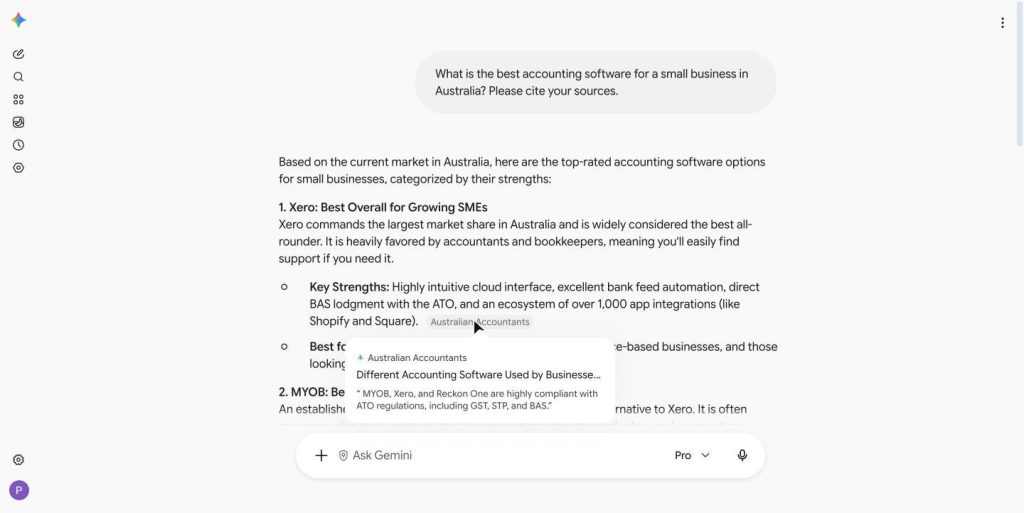
A Google Gemini answer to a business question, with one of its cited sources shown.
Use of these tools is growing fast. OpenAI reported more than 900 million weekly active ChatGPT users in February 2026. In Australia, the Telsyte Australian AI Study 2026 found 13.8 million Australians use ChatGPT. Australians are also using AI to shop: an Omnisend survey found 34% of Australian consumers use generative AI for product research. If you are deciding which tools to try yourself, start with our list of AI tools every marketer needs.
How GEO differs from SEO
SEO targets a ranking algorithm. GEO targets an AI model that decides which sources to quote. The goal shifts from ranking to being cited, and the signals shift with it:
- Structured data that helps AI systems understand what a page is about.
- Authoritative sourcing, including original data and expert opinion worth quoting.
- E-E-A-T (experience, expertise, authoritativeness and trustworthiness) signals across your site and the wider web.
- Direct answers in self-contained paragraphs that an AI can lift cleanly.
- An llms.txt file, an emerging standard that points AI crawlers to your most important pages.
Search is also no longer one channel. Our guide on how different search engines affect your marketing strategy covers how each platform changes where your audience finds you.
 Why Australian businesses need to pay attention now
 Why Australian businesses need to pay attention now
AI answers are moving into buying decisions. Semrush’s AI Overviews Study found the share of commercial keywords triggering an AI Overview rose from 8.15% in October 2024 to 18.57% in 2025, and transactional keywords rose from 1.98% to 13.94%. Google is pushing further with AI Mode, which we cover in what Google AI Mode means for Australian businesses.
Gartner predicted that traditional search engine volume would drop 25% by 2026 as people turn to AI chatbots, and that brands’ organic search traffic would fall by 50% or more by 2028. Brands that build GEO signals early get cited. Brands that wait risk becoming invisible in the answers their customers read.
What Is AEO (Answer Engine Optimisation)?
What answer engines are
Answer engine optimisation (AEO) targets the places where Google answers a question directly on the results page: featured snippets, People Also Ask boxes, voice search results, and knowledge panels. These features have existed since around 2015, and they have grown as searchers expect instant answers. Our guide to answer-based content shows how to write pages that win these spots.
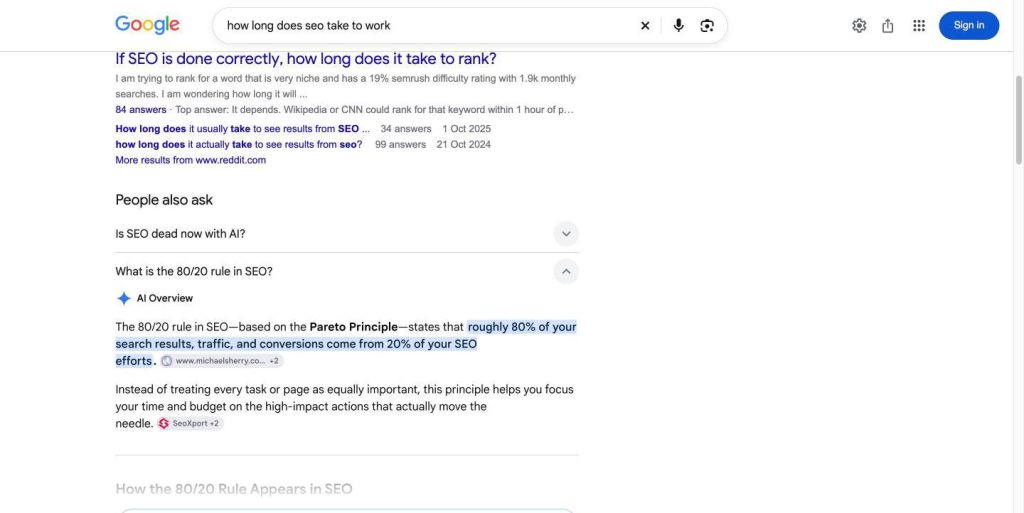
A People Also Ask box in Google results with an expanded direct answer. AEO aims to win these direct-answer spots.
How AEO differs from SEO and GEO
AEO still lives inside Google’s ecosystem, while GEO extends to standalone AI platforms like ChatGPT and Perplexity. The levers are structural: short, precise answers near the top of a page, FAQ and HowTo schema markup, and H2 and H3 headings phrased as the questions people ask.
The formats AEO targets are changing quickly. Ahrefs found featured snippets fell from 15.41% of US results pages in January 2025 to 5.53% in June 2025, while AI Overviews rose from 3.93% to 27.43% over the same period. Answer features also take clicks from the results below them. In Ahrefs’ featured snippet study, the snippet took about 8.6% of clicks and the number one result beneath it got 19.6%, against roughly 26% when no snippet appeared. More recent Ahrefs research found the top-ranking page earns 58% fewer clicks on average when an AI Overview is shown.
AEO and GEO: the overlap
Content optimised for AEO tends to perform well in GEO too. A page that opens with a clear two-sentence answer, uses question-based headings, and carries schema markup is easy for Google to extract as a snippet and easy for a language model to cite. The two are separate disciplines, but they share many of the same tactics. If you already invest in AEO, you have a head start on GEO. The main additions are building your brand’s presence on other trusted sites, publishing original data, and checking how AI tools describe you.
SEO vs GEO vs AEO: Side by Side
The three disciplines target different channels, but most businesses need a blend rather than a single choice. SEO drives volume from traditional results. AEO captures question-based searches inside Google. GEO builds visibility in AI-generated answers on and off Google. The work behind them overlaps more than the acronyms suggest, so the real decision is how to weight your effort, not which one to pick.
A practical rule: if your most valuable keywords still have ranking gaps, put most of your budget into SEO. If your pages rank but rarely win the snippet or answer box, add AEO. If competitors are being named in ChatGPT or Perplexity answers and you are not, add GEO. The comparison below shows how they differ across five dimensions.
Which One Does Your Australian Business Actually Need?
 Which One Does Your Australian Business Actually Need?
Start with SEO: it’s still the foundation
If you don’t rank in traditional search, GEO and AEO won’t make up for it. AI tools draw heavily on pages that search engines can already find and trust. SEO remains the highest-volume and most predictable organic channel for most Australian businesses. Even as AI use grows, the Telsyte study found only 12% of Australian AI users say AI is now their primary way of finding information online.
Layer in AEO if you’re in a question-heavy niche
Industries where customers research before they buy, such as finance, legal, health, home services and education, benefit most from AEO. If your target queries start with “how do I” or “what is”, AEO should be a high priority.
Start with the questions your sales and support teams hear every week. Turn each one into a clear heading, answer it in the first two sentences below that heading, then add detail. Mark up FAQ sections with schema so Google can read them, and keep answers short enough to fit a snippet.
Add GEO if you want to show up in AI answers
Any business with a research-heavy or tech-savvy audience should be building GEO signals now. Larger brands are already moving: Conductor’s 2026 survey of more than 250 US enterprise marketing leaders found 94% plan to increase AEO and GEO investment in 2026, after putting an average of 12% of digital budgets into it in 2025. The SEOFOMO State of AI Search Optimisation 2026 survey found 69% of search professionals now have a budget for AI search optimisation, up from 38% in 2025. In most Australian niches, it is still early enough to gain a first-mover advantage. For where this is heading, read our view on the future of digital marketing.
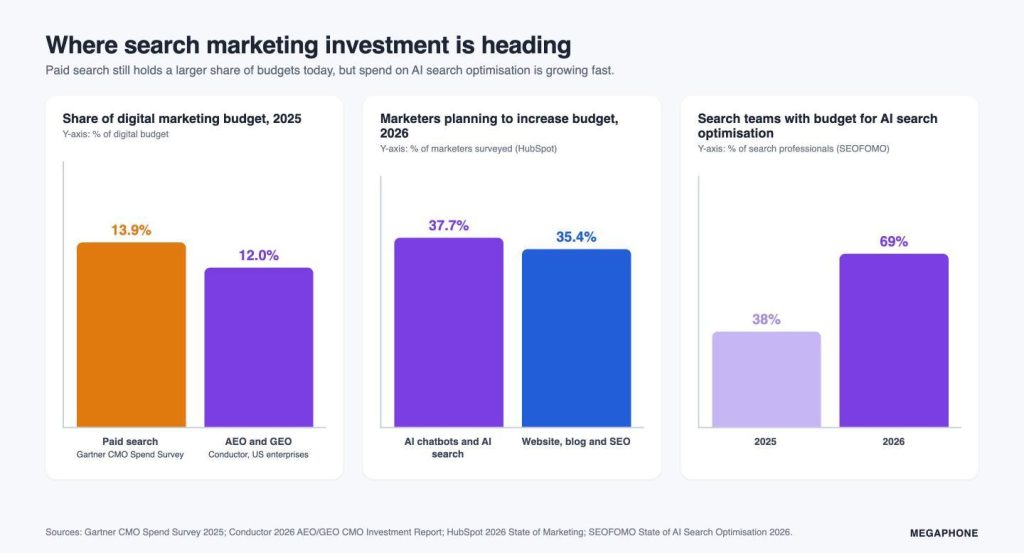
Sources: Gartner CMO Spend Survey 2025 (paid search share of digital budget); Conductor 2026 AEO/GEO CMO Investment Report (AEO/GEO share of digital budget, US enterprises); HubSpot 2026 State of Marketing (marketers planning to increase budget). Figures come from different surveys and are shown side by side for direction, not as a single allocation.
The ideal approach: all three working together
SEO, GEO and AEO reinforce each other rather than compete. A strong SEO foundation gives AI tools trusted pages to draw from. Well-structured AEO content is easy for language models to quote, which feeds GEO. Treating them as one strategy, rather than three separate projects, is the most efficient way to stay visible wherever your customers search.
What to Do Next
 What to Do Next
You can start on all three this week:
- Check your SEO baseline. Search your business name and your top five keywords in Google. Note where you rank and which competitors appear above you.
- Find your answer opportunities. List the questions customers ask before they buy, and check whether a featured snippet or AI Overview already answers them.
- Test your AI visibility. Ask ChatGPT, Gemini, and Perplexity the same questions. Record whether your brand is mentioned or cited, and which competitors are.
For more benchmarks to plan with, see our 131 essential digital marketing statistics.
Megaphone’s search engine optimisation services cover traditional SEO and GEO, so you can strengthen your rankings and build visibility in AI answers at the same time. Talk to our team about where your business should start.