If you have noticed fewer people clicking through to your website from Google over the past year, you are not alone. Google AI Mode launched in Australia on October 8, 2025, as Google announced, and it has changed how Australians search. AI-generated answers now sit above organic links, and for many queries, users get what they need without visiting a website. This guide covers Google AI Mode: What It Means for Australian Businesses. It explains what the product change does to your traffic and leads. It also outlines what your business should do about it.
What Google AI Mode means for Australian search
AI Mode is a dedicated tab in Google Search and the Google app, powered by a custom Gemini 2.5 model. It handles complex, exploratory questions that would normally take multiple searches. Users can ask by text, voice, or image, and the tool carries context across follow-up questions.
The sections below break down how AI Mode works, what controlled experiments and Australian case reports show about traffic impact, and where local businesses fit. We cover generative engine optimization strategy and AI Overviews optimization in separate posts.
How AI Mode works differently from standard search
AI Mode uses a technique called query fan-out. Instead of matching keywords to pages, it splits a question into subtopics. It runs multiple searches simultaneously across the web and Google’s Knowledge Graph, then synthesizes the results into one response. Google’s Search Central documentation says this surfaces a wider and more diverse set of links than classic search.
The custom Gemini 2.5 model supports multimodal input. Users can type, speak, or upload an image or file. In early testing, AI Mode queries averaged twice the length of traditional search queries, with users asking exploratory questions, comparing products, and planning trips.
An Ahrefs study analyzing 730,000 response pairs found AI Mode and AI Overviews reach 86% semantic similarity but cite different sources only 13.7% of the time. AI Mode responses are roughly 4x longer than AI Overviews and include 2.5x more people and brand entities.
AI Mode vs. AI Overviews: what changed for Australian search
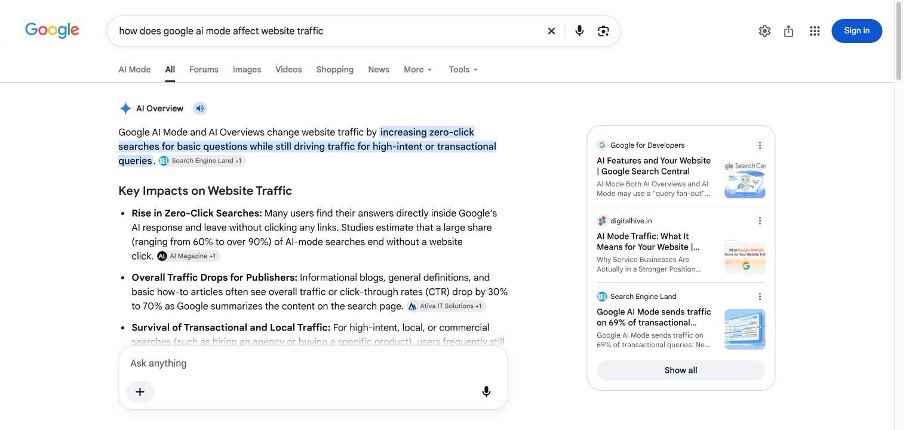
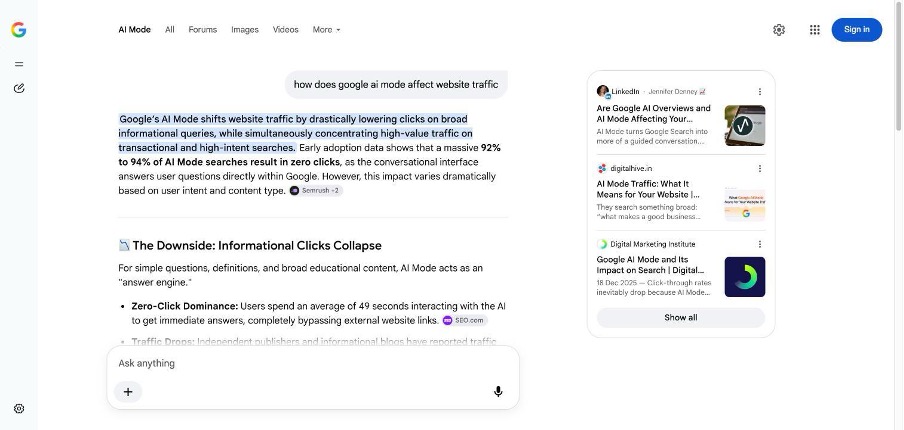
Image Source: Google SERP AI Overviews
AI Overviews reached Australia in 2024 as AI-generated summaries that appear automatically at the top of standard search results. AI Mode followed in October 2025 as a separate, opt-in tab with more advanced reasoning and multimodal capabilities.
Both use query fan-out, but AI Mode and AI Overviews may use different models and techniques, so the responses and links they show vary. Google’s documentation notes that AI Mode is designed for deeper exploration, reasoning, and complex comparisons. AI Overviews provide a quick snapshot with links to dig deeper.
Users can now transition from an AI Overview to AI Mode on mobile by selecting “Show more” and typing a follow-up question, with context carrying over. This means a user who starts with a quick snapshot can move into a deeper, multi-turn research session without losing their original query.
What AI Mode does to your website traffic
Industry data indicated that by mid-2025, over a third of searches in Australia led to an AI summary, even before AI Mode’s full rollout. A separate preregistered field experiment published in August 2026 measured the effect more precisely. Assigning participants to Google AI Mode cut click-through to external websites by 18.8 percentage points. When AI Mode was active, click-through to news sites fell 12.5 percentage points, Reddit dropped 21.2 points, and Wikipedia lost 9.9 points.
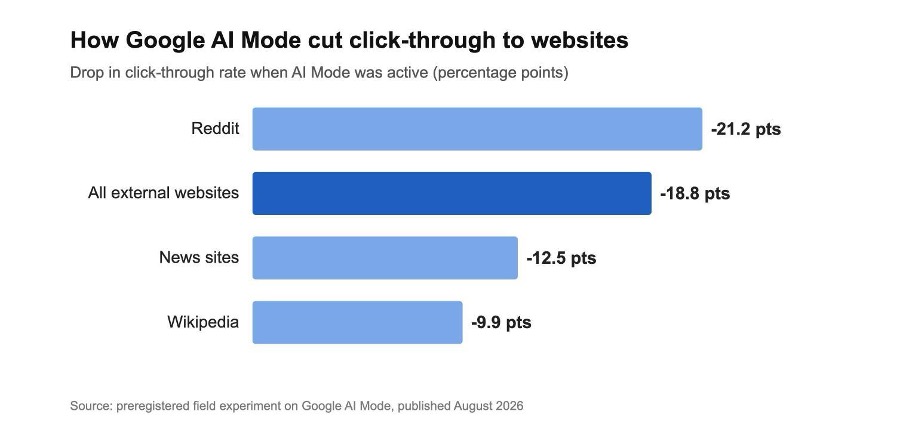
Google AI Mode CTR Impact
Separate research by Agarwal and Sen measured page-level impact. When an AI Overview appears on a results page, outbound organic clicks fall 39.8% and zero-click searches rise 34.5%. Australian report show a wide range, and the figures measure different things. Elliot Dean of Temerity Digital documented page-level click-through declines of 15 to 70% on pages where AI Overviews appear. Darren Woolley reported a single case with total site traffic down roughly 80%. StudioHawk warned of declines up to 80% in aggregate for content-heavy sites. SEOs more broadly have reported sites losing 20 to 60% of traffic correlated with increased AI Overviews. Analysis by the ABC using SimilarWeb data found that several of Australia’s largest news websites experienced year-on-year declines in organic search traffic. Some outlets were down by as much as 35%.
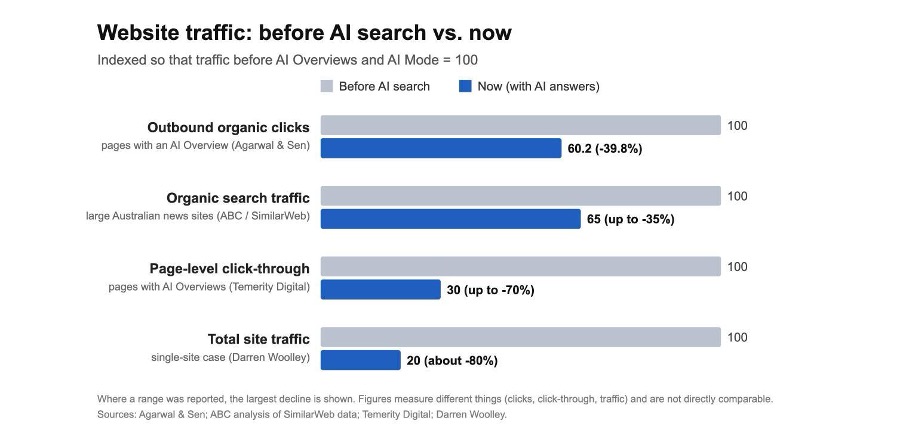
Website traffic before vs now after AI Mode
The impact varies sharply by query type. According to Semrush analysis of approximately 69 million U.S. Google sessions, cited in the Growth Memo meta-analysis by Kevin Indig and Amanda Johnson, 92 to 94% of AI Mode sessions result in zero external clicks. That figure measures the zero-click rate across all AI Mode sessions broadly, not a decline in outbound clicks for specific query categories. Transactional queries like “best” and product reviews tell a different story. Users still click through to compare options and make purchases.
Google’s John Mueller, from Search Relations, has acknowledged the shift. He said AI results may give people more context about a topic and display more relevant supporting links than classic Search. Google also says clicks from AI results are higher quality, with users spending more time on visited sites. He encouraged businesses to look at conversion indicators like sales, signups, and engaged audience rather than focusing solely on clicks.
There are early signs that AI-sourced traffic may convert better. Nick Grinberg, head of strategy at Next&Co, noted that AI traffic seems to convert better than standard organic search, possibly because users arrive more informed and prequalified. NerdWallet offers another concrete example: the company generated 35% more revenue in 2024 while losing 20% of monthly website traffic. Fewer clicks do not necessarily mean fewer conversions.
Where local businesses fit in AI Mode search
AI Mode’s query fan-out handles location-based queries by pulling from Google Business Profile data and the Knowledge Graph. For local service businesses, being cited in AI responses for queries like “best plumber in a given suburb” can drive visibility even without a traditional click.
Accurate NAP (Name, Address, Phone) consistency across your Google Business Profile and the Australian Business Register matters more than ever. If AI Mode pulls incorrect business information, it could misdirect potential customers.
Rocket Agency’s analysis found AI summaries mostly appear for informational searches rather than transactional or local service queries. This may shift as AI Mode evolves and more Australian users adopt it. Local businesses that maintain strong Google Business Profile data and gather reviews are better positioned to appear in AI-generated local answers.
How to adapt your content for AI Mode
Visibility in AI answers is becoming as important as ranking for keywords. AI Mode has no “10 blue links”; you either get cited or you don’t. In an internal audit of early-stage educational queries, Megaphone found 0% visibility in AI answers. The audited pages did not appear in AI-generated responses for those question types. The goal is not citation for its own sake but qualified leads and revenue. A page cited in an AI answer still needs clear calls to action, offer pages, and lead capture to turn that visibility into business outcomes.
- Format content with clear H2 headings, Q&A structures, bulleted lists, and direct answers to common questions so AI can parse it
- Strengthen E-E-A-T signals with named authors who have demonstrated expertise, authoritative sources, and trust signals like awards and certifications
- Add structured data markup such as FAQPage, Article, and LocalBusiness schema so AI can understand and reference your content
- Optimize for conversational and voice search, since AI Mode queries are longer and more natural-language than traditional searches
Our team has seen these principles work across editorial campaigns for Australian brands. Transactional and navigational queries still drive clicks, and strong organic rankings correlate with AI citation.
Frequently asked questions about Google AI Mode
Google AI Mode launched in Australia on October 8, 2025, and early data shows it is already reducing external clicks for many query types.
Is Google AI Mode available in Australia?
Yes. Google AI Mode rolled out to Australian users on October 8, 2025, as a dedicated tab in Google Search and the Google app. It is available in English and does not require a Labs sign-up. Ads in AI Mode are not yet available in Australia, but Google has said it is actively planning to bring advertising features to more markets soon.
How is AI Mode different from AI Overviews?
AI Overviews appear automatically at the top of standard search results. AI Mode is a separate tab you choose to use, and it carries context across follow-up questions so you can dig deeper without restating your question. On mobile, you can start in an AI Overview and select “Show more” to continue in AI Mode with your original query intact.
Should Australian businesses still invest in SEO?
Yes, but the strategy is shifting. Traditional SEO still matters for transactional and navigational queries, which retain near 100% click-through rates. For informational queries where AI answers now satisfy users before they click, the focus should shift toward being cited in those answers rather than ranking below them. If you are weighing your options, these considerations can help you choose the right approach.
Takeaways
- A preregistered field experiment found AI Mode reduced click-through to external websites by 18.8 percentage points in its study population
- 92 to 94% of AI Mode sessions result in zero external clicks, per Semrush analysis of approximately 69 million U.S. sessions
- Transactional queries retain near 100% click-through, so SEO still matters for bottom-funnel intent
- Strong E-E-A-T signals, structured data, and conversational formatting increase your chances of being cited in AI answers
- Google has not yet announced firm dates for Ads in AI Mode in Australia
Next steps for building AI visibility
Audit your current content to see which pages appear in AI answers and which have dropped off. In our audits, we prioritize visibility that drives qualified leads and revenue, not citation volume alone. Google Search Console does not yet report AI-specific impressions or citations, so manual spot checks remain necessary. Track which pages gain or lose citations in AI answers over time, and compare those changes against your pipeline contribution by query type.
Google Search Console does not yet report AI-specific impressions or citations, so manual spot checks remain necessary. Track which pages gain or lose citations in AI answers over time, and compare those changes against your pipeline contribution by query type.
Prioritize content that AI Mode is most likely to cite: answer-based, well-structured, and authoritative. As a Google Premier Partner with 100+ digital marketing experts and experience across over 500 brands, Megaphone can audit your current visibility in AI search results. We can build a plan to improve it. Book a consultation to see where you stand and what to fix first.